

As the use of generative AI expands, the importance of technologies capable of efficiently running Large-Scale Language Models (LLM) in real-world service environments is growing. Along with improvements in model performance, power consumption, operating costs, and data processing efficiency during the inference process have emerged as key competitive factors for AI infrastructure. AI semiconductor companies are also striving to develop proprietary semiconductor architectures optimized for LLM inference, in addition to general-purpose computing performance. Kim Joo-young, CEO of HyperXcel, who has been developing such technologies, has been selected as a key figure in the domestic AI industry.
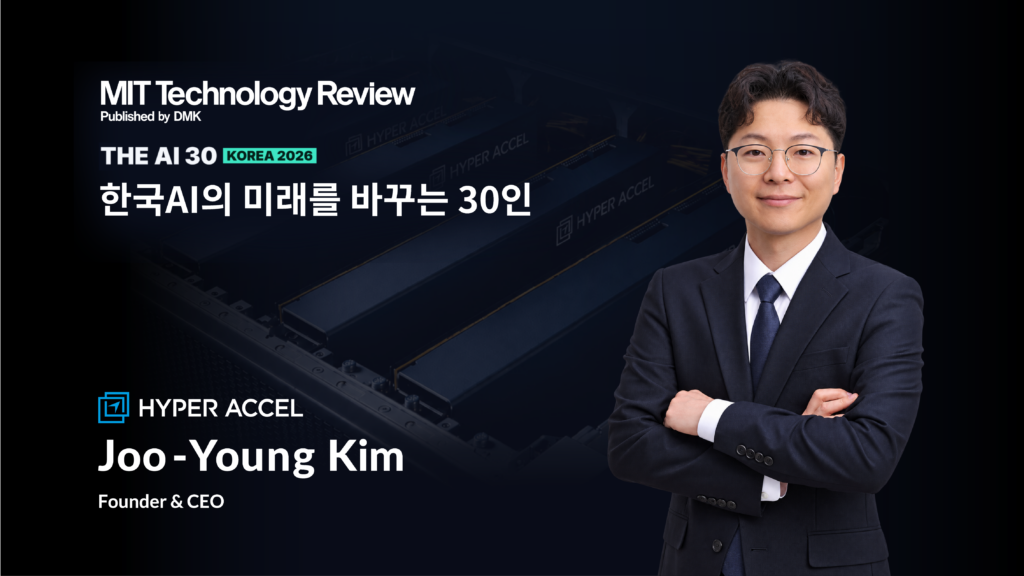
HyperAccel, an AI semiconductor fabless startup, announced that CEO Joo-Young Kim was selected for MIT Technology Review Korea’s “THE AI 30: 30 People Changing the Future of AI in Korea.”
‘THE AI 30’ is an annual project that selects 30 individuals who have contributed to the development of the Korean AI industry in various fields, including AI model development, semiconductors, robotics, and industrial applications. It highlights figures who have led changes in the industry based on research, technology, and business achievements confirmed over the past year.
CEO Kim Joo-young has been leading the development of the LPU (LLM Processing Unit), an AI semiconductor specialized for large-scale language model inference. HyperExcel has focused on the fact that the characteristics of the AI model training process differ from the inference process that handles user requests in actual services, and is developing a semiconductor architecture optimized for LLM inference.
Development of LPDDR5X-based LPU… From Data Centers to On-Device AI
HyperExcel is an AI semiconductor fabless startup founded by Professor Joo-Young Kim of KAIST in 2023. Based on a proprietary LPU architecture, it is developing technology that improves the processing efficiency of LLM inference and reduces power consumption and operating costs.
One of the core technologies is a proprietary semiconductor design utilizing LPDDR5X memory. LPDDR5X is a memory standard characterized by low power consumption, and HyperExcel is focusing on reducing the data processing burden and power consumption generated during AI inference based on this technology.
The company views the ability to process a large number of tokens relative to cost and power consumption as just as simple computational speed when evaluating the performance of AI semiconductors. As the usage of LLM services increases, so do the computational resources and power costs required for inference; therefore, the strategy is to secure semiconductor technology that enhances token processing efficiency as a competitive advantage.
Key products include ‘Bertha,’ an AI accelerator for data centers and enterprise environments, and ‘Bertha-Edge’ for on-device AI. HyperXcel plans to develop LPU products for data centers while expanding the scope of application to edge devices and physical AI in the future.
R&D achievements are also continuing. HyperExcel was selected as the best paper by IEEE Micro in 2025 and won the AI core technology and chip category at the Taiwan ICT Grand Challenge. In 2026, it received the Government Commendation for Merit in Information and Communications and the Deputy Prime Minister’s Award for Innovation at the World IT Show (WIS), and was also named to Forbes Asia’s ‘100 To Watch’.
It is also pursuing investment attraction and expansion of overseas business. HyperExcel is currently in the process of raising Series B investment, and the company has disclosed a cumulative investment of 210 billion won. Based on its headquarters in Seoul and a base in Silicon Valley, USA, it is pursuing entry into the global AI semiconductor market.
CEO Kim Joo-young stated, “Competition in the AI industry is expanding beyond model performance to how efficiently they can be operated and applied to actual industries,” adding, “HyperExcel will contribute to enabling more companies to efficiently utilize AI by improving the cost and power efficiency of AI infrastructure through semiconductor technology specialized in LLM inference.”